


2026 Explorer vs. Traverse, Highlander & Telluride: St. Louis, MO
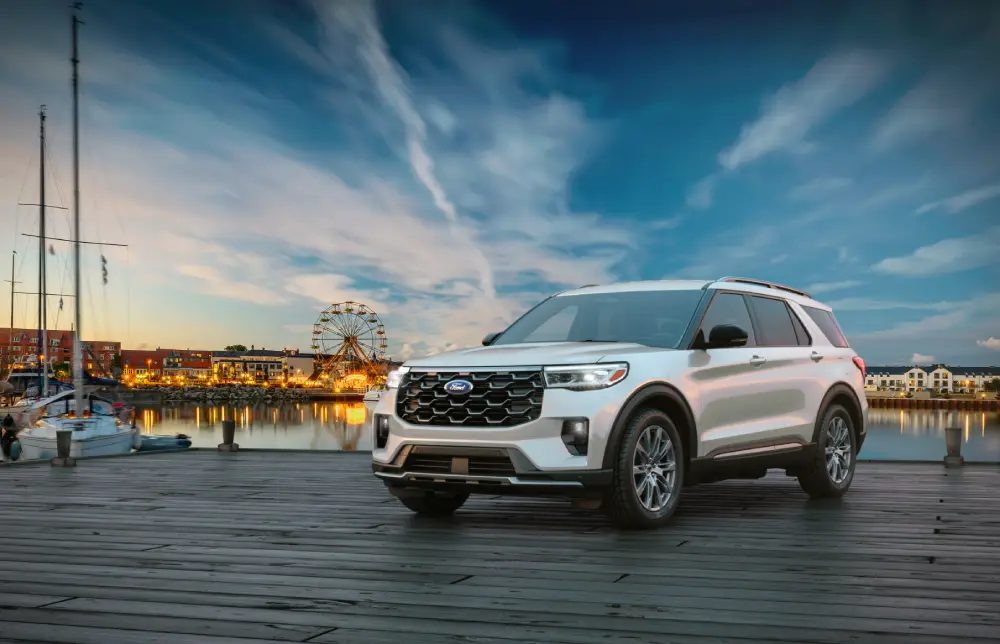
2026 Ford Explorer Overview
St. Louis families cross-shopping three-row SUVs are choosing between four genuinely different approaches to the segment, and the 2026 Ford Explorer makes its case against the Chevrolet Traverse, Toyota Highlander, and Kia Telluride with a sportier drive, a punchy optional V6, and the segment's only true off-road Tremor trim. The Explorer matches all three rivals on the class-standard 5,000-lb tow rating and starts at $40,585, close to the Traverse and meaningfully below the Highlander. Dave Sinclair Ford, located in St. Louis off Lindbergh Boulevard, stocks the Explorer trims that St. Louis families cross-shop against these three rivals. The sections below break down each matchup individually, backed by a full spec table and honest notes on where the Traverse, Highlander, and Telluride pull ahead.
2026 Explorer Side-by-Side Specs
Specs below reflect published manufacturer figures for properly equipped 2026 models and vary by trim and drivetrain.
| Spec | 2026 Ford Explorer | 2026 Chevrolet Traverse | 2026 Toyota Highlander | 2026 Kia Telluride |
|---|---|---|---|---|
| Engine / Horsepower | 2.3L EcoBoost I4 (300 hp) standard; 3.0L EcoBoost V6 (400 hp, ST) | 2.5L turbo I4 (328 hp), only engine offered | 2.4L turbo I4 (265 hp), standard AWD | 3.8L V6 (291 hp), standard on all trims |
| Max Towing | 5,000 lbs | 5,000 lbs | 5,000 lbs | 5,000 lbs (5,500 lbs, X-Pro) |
| Cargo (behind rear seats) | 16.3 cu ft | 22.9 cu ft | 16.0 cu ft | 21.0 cu ft |
| EPA MPG (combined) | 24 (RWD gas); 21 (V6) | 23 | 24 | 23 |
| Starting MSRP | $40,585 | $40,800 | $47,065 | $36,390 |
| Warranty | 3-yr/36,000-mi basic, 5-yr/60,000-mi powertrain | 3-yr/36,000-mi basic, 5-yr/60,000-mi powertrain | 3-yr/36,000-mi basic, 5-yr/60,000-mi powertrain | 5-yr/60,000-mi basic, 10-yr/100,000-mi powertrain |
2026 Explorer Head-to-Head Basics & Shopping Overview
How does the 2026 Explorer compare overall to the Traverse, Highlander, and Telluride for St. Louis families?
St. Louis families cross-shopping three-row SUVs will find the 2026 Explorer competitive on price and towing, matching all three rivals at a 5,000-lb tow rating while offering a sportier drive and the segment's only Tremor off-road trim. The Traverse counters with significantly more cargo space, the Highlander with Toyota's reliability reputation, and the Telluride with the lowest starting price and the longest powertrain warranty of the group. St. Louis families who want a sportier driving feel or off-road capability tend to gravitate toward the Explorer. Detailed matchup sections against each competitor follow below.
Which of these four three-row SUVs is most popular among St. Louis families?
The Ford Explorer has a long history as one of America's best-selling SUVs and maintains strong demand in the St. Louis market. The Kia Telluride has won numerous industry awards and built a devoted following despite occasional inventory constraints. The Chevrolet Traverse and Toyota Highlander both draw buyers who prioritize maximum interior space or long-term reliability respectively. St. Louis's large family population supports demand across all four SUVs. Sales volume is one data point, though the right SUV still depends on specific family needs.
What does the 2026 Explorer cost compared to the Traverse, Highlander, and Telluride?
The 2026 Explorer starts at $40,585, close to the Traverse's $40,800, well below the Highlander's $47,065, and above the Telluride's $36,390 starting price. These are base trim MSRP figures before destination fees and options. St. Louis shoppers comparing all four should also factor in current manufacturer incentives, which shift regularly. Dave Sinclair Ford can provide current Explorer pricing and available offers for a direct comparison.
Does the Explorer hold its value as well as its competitors?
The Ford Explorer has a solid, long-established resale reputation as one of the longest-running nameplates in the segment. The Toyota Highlander and Kia Telluride both carry strong resale reputations as well, with the Telluride specifically noted for award-winning resale value. The Chevrolet Traverse generally sees more typical depreciation for a mainstream three-row SUV. St. Louis families planning to trade in or sell later should weigh the Highlander and Telluride's stronger reputations against the Explorer's sportier driving character.
What Explorer trim fits a St. Louis family that wants a sportier drive and more power?
A St. Louis family that wants a sportier drive and more power should look at the Explorer ST-Line or ST, the latter offering the available 3.0L EcoBoost V6 with 400 horsepower, well beyond anything the Traverse, Highlander, or Telluride offer in their mainstream trims. Families who prioritize off-road capability instead should look at the new Explorer Tremor trim with its lifted suspension and limited-slip rear differential. A Dave Sinclair Ford sales consultant can help match trim to a St. Louis family's priorities between performance, off-road capability, and value. The base Active trim still delivers strong performance with its standard 2.3L EcoBoost engine.
How do Explorer trim levels compare to Traverse, Highlander, and Telluride trim structures?
The 2026 Explorer runs from Active through ST-Line, Tremor, Platinum, and the performance-focused ST. The Traverse spans LT through Z71, High Country, and RS, the Highlander from XLE through Platinum, and the Telluride from LX through SX Prestige with X-Line and X-Pro variants. Each brand structures its lineup around a similar value-to-premium spectrum, though standard features and available powertrains vary meaningfully by trim. St. Louis shoppers comparing trims should confirm which safety and technology features are standard at each price point.
How should a St. Louis family decide between these four three-row SUVs?
A St. Louis family weighing the 2026 Explorer, Traverse, Highlander, and Telluride should start with which factors matter most day to day since the Explorer offers the sportiest drive and off-road option, the Traverse the most cargo and passenger room, the Highlander the strongest reliability reputation, and the Telluride the lowest price and longest warranty. Test driving more than one back to back is the clearest way to judge the real differences in ride quality and third-row comfort. St. Louis's mix of daily commuting and family road trips rewards different strengths depending on the family's priorities. Dave Sinclair Ford can arrange test drives and address the trade-offs that matter most.
What is the next step for a St. Louis family ready to compare these SUVs in person?
The clearest next step for a St. Louis family is scheduling a 2026 Explorer test drive at Dave Sinclair Ford and bringing notes on which competitor strengths matter most, whether that is the Traverse's cargo room, the Highlander's reliability reputation, or the Telluride's price and warranty. Experiencing the Explorer's driving dynamics and available V6 power firsthand often clarifies the comparison faster than reading specs alone. Dave Sinclair Ford's team can pull current inventory and pricing for the specific Explorer configuration a St. Louis family has in mind. A side-by-side look at a competitor's SUV, where available, can help finalize the decision.
2026 Explorer vs. Traverse: Performance & Capability
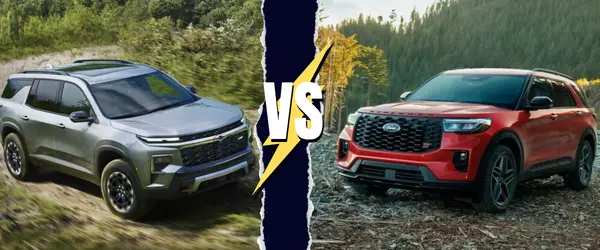
The 2026 Ford Explorer and 2026 Chevrolet Traverse both offer a 5,000-lb tow rating and turbocharged four-cylinder power, but the two SUVs diverge sharply on interior space and engine philosophy. The Traverse offers significantly more room throughout, with 22.9 cubic feet of cargo behind the third row versus the Explorer's 16.3 cubic feet, and seats up to eight passengers versus the Explorer's maximum of seven. The Explorer counters with a genuine performance option in its available 400-horsepower 3.0L EcoBoost V6, a choice the single-engine Traverse lineup does not offer, along with a Tremor off-road trim and rear-wheel-drive-based architecture that many reviewers describe as sportier to drive. Both SUVs start within about $215 of each other, with the Traverse slightly higher at $40,800 versus the Explorer's $40,585. For a St. Louis family that prioritizes maximum interior room, the Traverse is the stronger choice; for a family that wants a sportier drive or more power options, the Explorer pulls ahead.
2026 Ford Explorer vs. Traverse Questions
Which has more cargo space, the Explorer or the Traverse?
The 2026 Chevrolet Traverse offers significantly more cargo space than the 2026 Ford Explorer, with 22.9 cubic feet behind the third row compared to the Explorer's 16.3 cubic feet, and a maximum of 97.6 cubic feet with all seats folded versus the Explorer's 85.8 cubic feet. That gap is one of the largest in this comparison set and reflects the Traverse's more space-focused design priorities. St. Louis families who regularly haul luggage with all three rows occupied will feel this difference directly. The Explorer remains adequate for typical family use but trails clearly here.
Does the Explorer or the Traverse offer more engine choices?
The 2026 Ford Explorer offers two engine choices, a standard 2.3L EcoBoost four-cylinder and an available 400-horsepower 3.0L EcoBoost V6 on the ST and Tremor, while the 2026 Chevrolet Traverse offers only one engine, a 2.5L turbocharged four-cylinder making 328 horsepower, across its entire lineup. That gives Explorer buyers more flexibility to choose between everyday efficiency and genuine performance. The Traverse's single engine is tuned for a strong balance of power and simplicity. St. Louis buyers who want a performance option should lean toward the Explorer ST.
Which seats more passengers, the Explorer or the Traverse?
The 2026 Chevrolet Traverse can seat up to eight passengers with its no-cost second-row bench option, while the 2026 Ford Explorer tops out at seven passengers. That extra seat can matter for larger St. Louis families or those who frequently carpool. Both SUVs offer captain's chair second-row configurations as alternatives. Families who need maximum seating capacity should lean toward the Traverse.
Is the Explorer or the Traverse more fun to drive?
The 2026 Ford Explorer is generally regarded as the sportier-driving SUV in this matchup, benefiting from its rear-wheel-drive-based architecture and available V6 power, with reviewers noting it suits buyers who care how a vehicle feels behind the wheel. The 2026 Traverse prioritizes interior space and straightforward capability over driving dynamics. Neither SUV drives poorly; the difference is a matter of character and priorities. St. Louis buyers who value a more engaging drive should lean toward the Explorer.
Are the Explorer and Traverse similarly safe SUVs?
Both the 2026 Explorer and the 2026 Traverse come with a full suite of standard driver-assist features, including automatic emergency braking and lane-keeping assist. The Traverse adds some features standard that require higher trims on the Grand Highlander, and both SUVs perform well in independent testing. Neither SUV has a documented safety shortfall. St. Louis families comparing these two on safety should confirm which specific features are standard at their preferred trim level.
Is the Explorer or the Traverse the better value?
The 2026 Ford Explorer and 2026 Chevrolet Traverse start within about $215 of each other, at $40,585 and $40,800 respectively, making this one of the closest price matchups in the segment. The Traverse offers substantially more cargo and passenger space at that price, while the Explorer offers more engine choices and a sportier driving character. Neither SUV is a clear overall value winner; the right choice depends on whether a St. Louis family prioritizes maximum room or driving engagement. Both are reasonable choices at essentially the same starting price.
Which is better for a St. Louis family that regularly road trips with all three rows full?
A St. Louis family that regularly road trips with all three rows occupied should strongly consider the 2026 Traverse, since its 22.9 cubic feet of cargo space behind the third row is significantly more usable for luggage than the Explorer's 16.3 cubic feet in that same configuration. The Explorer remains a capable road-trip SUV but will require more strategic packing with a full complement of passengers. Families who occasionally use the third row but usually travel with fewer passengers may find the Explorer's cargo space adequate. The Traverse's space advantage is most relevant specifically for full-capacity trips.
Which has better infotainment technology, the Explorer or the Traverse?
The 2026 Chevrolet Traverse offers a standard 17.7-inch touchscreen with Google Built-In, one of the largest standard displays in the segment, ahead of the 2026 Explorer's standard 13.2-inch touchscreen. The Explorer counters with the Ford Digital Experience system, which integrates Google and Amazon services alongside standard wireless Apple CarPlay and Android Auto. Both systems are modern and well-reviewed, so the Traverse's screen size advantage is more about scale than functionality. St. Louis families who prioritize the largest possible display may lean toward the Traverse.
2026 Explorer vs. Highlander: Interior, Technology & Comfort
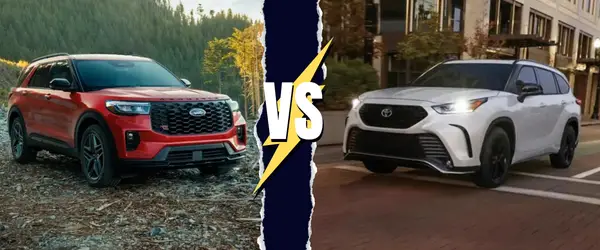
The 2026 Ford Explorer and 2026 Toyota Highlander take different paths to family SUV duty, with the Highlander leaning on Toyota's reliability reputation and the Explorer leaning on performance and value. The Explorer starts at $40,585, a full $6,480 below the Highlander's $47,065 starting price, and offers a more powerful base engine at 300 horsepower versus the Highlander's 265 horsepower. The Highlander counters with standard all-wheel drive across its entire 2026 lineup, an available hybrid powertrain the Explorer does not offer, and Toyota's well-documented reputation for long-term reliability and resale value. Both SUVs offer similar cargo space behind the third row, with the Explorer at 16.3 cubic feet and the Highlander close behind at 16.0 cubic feet, both trailing the segment's more space-focused rivals. For a St. Louis family focused on value, power, and a sportier drive, the Explorer is the stronger choice; for a family that wants standard AWD, hybrid efficiency, and Toyota's reliability reputation, the Highlander holds real appeal.
2026 Explorer vs. Highlander Questions
How much cheaper is the Explorer than the Highlander?
The 2026 Ford Explorer starts at $40,585, compared to the 2026 Toyota Highlander's $47,065 starting price, a difference of $6,480. That gap partly reflects the Highlander's now-standard all-wheel drive for 2026, a feature that costs extra on some Explorer trims. St. Louis families focused on the lowest entry price will find the Explorer's advantage substantial. Buyers should still compare similarly equipped AWD trims from both SUVs for a fully fair price comparison.
Does the Highlander offer a hybrid option that the Explorer doesn't?
Yes, the 2026 Toyota Highlander offers a hybrid powertrain rated up to 35 mpg combined, an option the 2026 Ford Explorer does not currently offer in any trim. That makes the Highlander the more fuel-efficient choice for St. Louis families who prioritize lower running costs over outright power. The Explorer's gas-only engines still deliver competitive fuel economy for the segment, particularly with the standard 2.3L EcoBoost. Families who specifically want hybrid efficiency in a three-row Toyota should also consider the larger Grand Highlander Hybrid.
Which has more power, the Explorer or the Highlander?
The 2026 Ford Explorer's standard 2.3L EcoBoost engine makes 300 horsepower, ahead of the 2026 Highlander's 265-horsepower 2.4L turbo engine across its lineup. The Explorer's available 400-horsepower 3.0L EcoBoost V6 widens that gap further for buyers who choose the ST or Tremor trims. The Highlander's hybrid option prioritizes efficiency over outright power. St. Louis families who want the most power in this matchup should lean toward the Explorer.
Is the Highlander more reliable than the Explorer?
The 2026 Toyota Highlander benefits from Toyota's long-standing reputation for reliability and strong resale value, a reputation built over many generations of the nameplate. The 2026 Ford Explorer has a solid but more mixed reliability history across recent generations. Buyers who weigh long-term reliability reputation most heavily may lean toward the Highlander's established track record. This is a real consideration worth researching for the specific model years and trims being compared.
Does the Explorer or the Highlander have more cargo space behind the third row?
The 2026 Ford Explorer and 2026 Toyota Highlander are very close on cargo space behind the third row, with the Explorer at 16.3 cubic feet and the Highlander at 16.0 cubic feet. Both trail more space-focused rivals like the Traverse and Telluride in this specific measurement. St. Louis families who prioritize maximum cargo room with all three rows occupied may want to consider the Traverse or Telluride instead of either the Explorer or Highlander. Between just these two, the difference is negligible for most practical purposes.
Is the Explorer or the Highlander the better value?
The 2026 Ford Explorer is the clearer value choice on price and power, starting $6,480 below the 2026 Highlander while offering more horsepower in its standard engine. The Highlander counters with standard AWD, an available hybrid, and Toyota's reliability reputation, which some buyers will pay a premium for. Shoppers focused on lower purchase price and more power should favor the Explorer. Shoppers who prioritize reliability reputation and hybrid efficiency may find the Highlander worth its higher price.
Which is better for a St. Louis family that wants standard all-wheel drive without upgrading trims?
The 2026 Toyota Highlander offers standard all-wheel drive across its entire 2026 lineup, removing any guesswork for St. Louis families who want AWD without researching which specific Explorer trim includes it. The 2026 Explorer offers AWD as an available option on most trims, which adds cost over the RWD-based Active model. Families who consider AWD non-negotiable for winter driving may find the Highlander's standard inclusion simpler to shop for. Families comfortable configuring the right Explorer trim can still get AWD, often at a lower total price than the Highlander.
Which has better technology features, the Explorer or the Highlander?
The 2026 Explorer offers a 13.2-inch standard touchscreen paired with a 12.3-inch digital instrument cluster across its lineup. The 2026 Highlander offers an 8-inch standard touchscreen with a larger 12.3-inch unit reserved for Limited and Platinum trims, meaning base Highlander buyers get a smaller standard display than base Explorer buyers. Both systems support wireless Apple CarPlay and Android Auto. St. Louis families who want the larger screen standard at a lower trim level should lean toward the Explorer.
22026 Explorer vs. Telluride: Safety & Technology
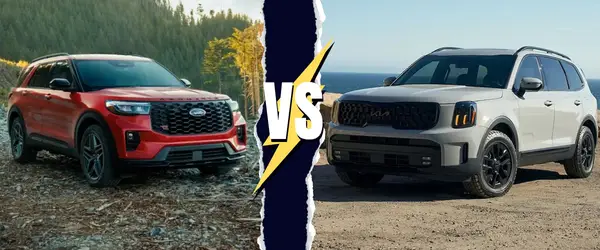
The 2026 Ford Explorer and 2026 Kia Telluride sit close in capability but far apart in price, with the Telluride's $36,390 starting price sitting $4,195 below the Explorer's $40,585. The Telluride backs that value with Kia's exceptional 10-year, 100,000-mile powertrain warranty, the longest in this entire comparison, and 21.0 cubic feet of cargo space behind the third row versus the Explorer's 16.3 cubic feet. The Explorer counters with more standard horsepower, 300 versus the Telluride's 291, and an available 400-horsepower V6 along with a genuine off-road Tremor trim the Telluride's lineup does not match. Both SUVs match at a 5,000-lb standard tow rating, with the Telluride's X-Pro trim edging ahead at 5,500 lbs. For a St. Louis family focused on price, warranty length, and cargo space, the Telluride is the stronger choice; for a family that wants more power options and off-road capability, the Explorer pulls ahead.
2026 Explorer vs. Telluride Questions
How much cheaper is the Telluride than the Explorer?
The 2026 Kia Telluride starts at $36,390, compared to the 2026 Ford Explorer's $40,585 starting price, a difference of $4,195. That makes the Telluride one of the most affordable entry points into the three-row SUV segment among these four competitors. St. Louis families focused on the lowest purchase price will find the Telluride's advantage significant. Buyers should still compare similarly equipped trims from both SUVs for a fully fair price comparison.
Does the Telluride have a better warranty than the Explorer?
Yes, the 2026 Kia Telluride's 10-year, 100,000-mile powertrain warranty is dramatically longer than the 2026 Ford Explorer's 5-year, 60,000-mile powertrain coverage. That is one of the most significant differences in this entire comparison and a genuine, well-documented Telluride advantage. St. Louis families who plan to keep an SUV for a decade or more may find this warranty gap especially meaningful. The Telluride's 5-year, 60,000-mile basic warranty also beats the Explorer's 3-year, 36,000-mile basic coverage.
Which has more cargo space, the Explorer or the Telluride?
The 2026 Kia Telluride offers 21.0 cubic feet of cargo space behind the third row, well ahead of the 2026 Ford Explorer's 16.3 cubic feet. That gap can matter for St. Louis families who frequently travel with all three rows occupied and need real luggage capacity. The Telluride's cargo advantage is consistent and well documented across independent reviews. Families who prioritize maximum usable cargo space with all seats in use should lean toward the Telluride.
Does the Explorer offer more power than the Telluride?
The 2026 Ford Explorer's standard 2.3L EcoBoost engine makes 300 horsepower, slightly ahead of the 2026 Telluride's 3.8L V6 at 291 horsepower. The Explorer's available 400-horsepower 3.0L EcoBoost V6 on the ST widens that gap considerably for buyers who want maximum power. The Telluride does not currently offer a performance trim comparable to the Explorer ST. St. Louis families who want the most powerful available engine in this matchup should lean toward the Explorer.
Are the Explorer and Telluride similarly safe SUVs?
Both the 2026 Explorer and the 2026 Telluride come with a full suite of standard driver-assist features, including automatic emergency braking, blind-spot warning, and lane-keeping assist through Kia Drive Wise and Ford Co-Pilot360 respectively. Neither SUV has a documented safety shortfall in independent testing. The Telluride includes second-row side airbags as standard equipment, a notable inclusion. Both SUVs are reasonable choices for safety-conscious St. Louis families.
Is the Explorer or the Telluride the better value?
The 2026 Kia Telluride is the stronger overall value in this matchup, combining a lower starting price, more cargo space, and a dramatically longer powertrain warranty than the 2026 Explorer. The Explorer counters with more standard power and off-road capability through its Tremor trim, real advantages for specific buyer priorities. Shoppers focused on price, warranty, and cargo space should clearly favor the Telluride. Shoppers who specifically want more power or off-road capability may find the Explorer worth its higher price for those features.
Which is better for a St. Louis family planning to keep their SUV for a decade or more?
A St. Louis family planning long-term ownership should weigh the 2026 Telluride's 10-year, 100,000-mile powertrain warranty heavily, since it provides significantly more protection over a decade-plus ownership period than the 2026 Explorer's 5-year, 60,000-mile coverage. The Telluride's strong resale reputation adds to its long-term value case. Families who prioritize maximum power or off-road capability enough to accept less warranty coverage may still prefer the Explorer. For pure long-term cost protection, the Telluride's warranty advantage is difficult for the Explorer to match.
Which has more advanced standard technology, the Explorer or the Telluride?
The 2026 Telluride offers a 12.3-inch touchscreen and 19 active safety systems standard even on the entry-level LX trim, a strong showing for a lower-priced SUV. The 2026 Explorer offers a comparable 13.2-inch touchscreen and 12.3-inch digital cluster across its lineup as well. Both SUVs are well equipped with modern technology at their respective price points. St. Louis families should compare specific driver-assist features standard at each trim level they are considering.
2026 Explorer Value & Cost of Ownership vs the Competition
Looking at the 2026 Explorer alongside the Traverse, Highlander, and Telluride together, pricing spreads meaningfully: the Telluride starts lowest at $36,390, the Explorer follows at $40,585, the Traverse close behind at $40,800, and the Highlander highest at $47,065. Warranty coverage clearly favors the Telluride, whose 10-year, 100,000-mile powertrain warranty leads the group by a wide margin, while the Explorer, Traverse, and Highlander all carry the more typical 5-year, 60,000-mile powertrain terms. On cargo space, the Traverse leads with 22.9 cubic feet behind the third row, followed by the Telluride at 21.0 cubic feet, while the Explorer and Highlander trail at 16.3 and 16.0 cubic feet respectively. On resale, the Highlander and Telluride hold the strongest reputations of the four, backed by Toyota's reliability history and the Telluride's multiple industry awards, while the Explorer and Traverse generally see more typical depreciation. Financing and incentives shift often across all four SUVs, so a St. Louis family comparing total cost of ownership should factor in current manufacturer offers alongside these baseline figures.
2026 Explorer Value, Cost of Ownership & Financing
Which of the four SUVs, the Explorer, Traverse, Highlander, or Telluride, has the lowest starting price?
Among the four SUVs, the 2026 Kia Telluride has the lowest starting price at $36,390. The 2026 Ford Explorer follows at $40,585, the 2026 Chevrolet Traverse close behind at $40,800, and the 2026 Toyota Highlander has the highest starting price at $47,065. These figures reflect base trim MSRP before destination charges and options. St. Louis shoppers focused purely on entry price should start with the Telluride.
How does the Explorer's price compare once cargo space is factored in?
When cargo space is weighed against price, the 2026 Telluride offers a strong combination of a lower starting price and more cargo room than the Explorer, while the Traverse offers the most cargo space of the group at a price close to the Explorer's own. The Explorer's price sits in the middle of this group while trailing on cargo space specifically. Families who prioritize maximum cargo room per dollar should look closely at the Traverse or Telluride. The Explorer's value case rests more on its power options and driving character than outright interior space.
Which of these SUVs costs the least to maintain over time?
Maintenance costs across the 2026 Explorer, Traverse, Highlander, and Telluride vary by engine complexity and brand reliability history, with the Highlander generally expected to have lower long-term maintenance costs based on Toyota's reliability reputation. The Telluride's well-regarded V6 also has a solid maintenance track record. The Explorer and Traverse's turbocharged four-cylinder engines may require more attentive maintenance over time than naturally aspirated alternatives. Buyers focused on minimizing long-term maintenance costs should weigh the Highlander and Telluride's reputations heavily.
Does the Telluride's longer warranty change the total cost of ownership picture?
The 2026 Telluride's 10-year, 100,000-mile powertrain warranty is significantly longer than the 5-year, 60,000-mile terms on the Explorer, Traverse, and Highlander, which can meaningfully reduce total repair costs for families who keep an SUV well past 60,000 miles. Families who trade in or sell before hitting that mileage threshold will see less practical benefit from the extended coverage. This is a genuine trade-off worth weighing against the Explorer's power options and off-road Tremor trim. St. Louis families planning long-term ownership should factor this warranty gap into their total cost comparison.
Are financing offers similar across the Explorer, Traverse, Highlander, and Telluride?
Financing and lease offers change frequently across all four manufacturers and are not fixed features of any of these SUVs, so current promotional APRs and lease terms should always be confirmed at the time of purchase. Ford, Chevrolet, Toyota, and Kia each run their own regional and national incentive programs that can shift monthly. A buyer comparing total cost across these four SUVs should request current financing terms for the specific vehicle and trim being considered. Dave Sinclair Ford can walk shoppers through current Explorer financing and lease options as part of that comparison.
Which of these SUVs is expected to hold its value best over time?
The 2026 Toyota Highlander and 2026 Kia Telluride both hold strong documented resale reputations among these four SUVs, with the Highlander benefiting from Toyota's long-term reliability history and the Telluride from multiple industry awards and strong owner satisfaction. The 2026 Explorer and 2026 Traverse generally see more typical depreciation patterns for mainstream three-row SUVs. St. Louis families planning to trade in or sell within a few years should weigh this resale pattern alongside upfront price and capability.
Which SUV offers the best overall value for a St. Louis family that wants power and off-road capability?
For a St. Louis family that specifically wants power and off-road capability, the 2026 Explorer offers the strongest overall package among these four SUVs, with its available 400-horsepower V6 and the segment's only dedicated off-road Tremor trim. The Telluride and Traverse do not offer comparable performance or off-road options in their current lineups. The Highlander's hybrid prioritizes efficiency over power. Families whose top priority is power or off-road capability specifically will find the Explorer the clear choice among this group.
Considering price, capability, and resale together, which SUV offers the best overall long-term value?
No single SUV among the 2026 Explorer, Traverse, Highlander, and Telluride wins on every long-term value measure, since each makes a different trade-off between price, capability, warranty, and resale. The Telluride combines a low price with the longest warranty and strong resale, making it a well-rounded choice for many families. The Traverse wins on interior space, the Highlander on reliability reputation, and the Explorer on power and off-road capability. A test drive and a real conversation about specific family needs, at Dave Sinclair Ford or elsewhere, remains the best way to weigh these trade-offs.
2026 Ford Explorer: Why St. Louis Families Choose Dave Sinclair Ford
St. Louis families comparing the 2026 Explorer against the Traverse, Highlander, and Telluride do not have to leave the city to do it in person. Dave Sinclair Ford has sold and serviced Fords from its South County location along Lindbergh Boulevard for decades, making it one of the longer-standing Ford dealerships in the St. Louis market. The dealership is locally owned and family operated, with an on-site service department staffed by certified Ford technicians who work on Explorers of every model year and engine configuration. Dave Sinclair Ford also offers a Warranty Forever program on qualifying vehicles, giving St. Louis families additional peace of mind on top of Ford's factory coverage. For a St. Louis family that wants a straightforward comparison from a dealership with deep roots in the city, Dave Sinclair Ford is a natural stop.
2026 Ford Explorer Local Availability & Dealer Trust
Can St. Louis shoppers find the 2026 Explorer in stock at Dave Sinclair Ford?
Dave Sinclair Ford carries a range of 2026 Explorer trims and configurations, and St. Louis shoppers can check current inventory online or by calling the dealership directly. Popular configurations, particularly ST-Line and Tremor models, can move quickly given strong family SUV demand. The dealership can also help locate or order a specific Explorer build if the exact trim, color, or option package a St. Louis family wants is not currently on the lot. Dave Sinclair Ford's sales team can confirm what is in stock and what can be sourced.
Where in St. Louis is Dave Sinclair Ford located?
Dave Sinclair Ford is located at 7466 S Lindbergh Blvd in St. Louis, in the South County area, easily reached from most parts of the metro via I-55, I-270, or Lindbergh Boulevard itself. The dealership's central South County position makes it a practical stop for St. Louis families coming from the city, South County, or nearby West County and Jefferson County communities. Exact drive times vary by starting neighborhood, but Lindbergh Boulevard connects directly to most major St. Louis-area highways. St. Louis shoppers can confirm directions and current traffic conditions before heading over.
How experienced is Dave Sinclair Ford with Explorer sales and service?
Dave Sinclair Ford has served the St. Louis and South County area as a Ford dealership for decades, giving its sales and service teams deep familiarity with the Explorer across many model years and engine options. The on-site service department is staffed by certified Ford technicians trained on current Explorer systems, including its EcoBoost four-cylinder and V6 powertrains. That experience matters for St. Louis families with detailed questions about trims, towing packages, or long-term ownership. St. Louis shoppers can expect a sales team familiar with how the Explorer compares to the Traverse, Highlander, and Telluride.
Is Dave Sinclair Ford a good choice for a St. Louis family that wants a straightforward buying experience?
Dave Sinclair Ford's standing as a locally owned, family-operated dealership reflects decades of presence in the St. Louis market that families can weigh against their own priorities for a straightforward purchase. The dealership's sales and finance teams can walk through pricing, trade-in value, and current Explorer offers in one visit. St. Louis shoppers should ask directly about current inventory, pricing transparency, and financing options, since these can shift with ongoing promotions. Pairing a personal visit with recent customer reviews gives any St. Louis family a fuller picture before deciding.
What service support does Dave Sinclair Ford offer Explorer owners after the sale?
Dave Sinclair Ford's on-site service department, staffed by certified Ford technicians, handles routine maintenance, warranty repairs, and larger powertrain work for the Explorer using genuine Ford parts. St. Louis owners can schedule service at the South County location without needing to travel outside the metro for factory-trained expertise. The dealership's Warranty Forever program, available on qualifying vehicles, adds coverage beyond Ford's standard factory warranty terms. Together, certified service and extended coverage are designed to support Explorer owners well past the day of purchase.
Does Dave Sinclair Ford offer any extended coverage beyond the Explorer's factory warranty?
Yes, Dave Sinclair Ford offers a Warranty Forever program on qualifying vehicles that extends beyond the Explorer's standard 3-year, 36,000-mile basic and 5-year, 60,000-mile powertrain factory coverage. St. Louis families interested in the program should confirm current eligibility requirements and coverage details with the dealership at the time of purchase. For St. Louis families who put steady daily and road-trip miles on an Explorer, that extra layer of coverage can be a meaningful factor. Combining Ford's factory coverage with a dealership-backed program gives Explorer owners more than one safety net.
How can a St. Louis family schedule a test drive of the 2026 Explorer?
St. Louis families can schedule a 2026 Explorer test drive at Dave Sinclair Ford by calling the dealership directly or requesting an appointment online. Bringing specific questions about how the Explorer compares to the Traverse, Highlander, or Telluride can help the sales team tailor the test drive to what matters most. Families curious about the available V6 or Tremor trim should ask to drive those specific configurations. A test drive remains the most direct way to feel the differences this page describes on paper.
What should a St. Louis family bring or prepare before visiting Dave Sinclair Ford?
A St. Louis family should bring a general sense of how many passengers and how much cargo they typically travel with, since that shapes which Explorer trim and seating configuration makes the most sense. Having a trade-in vehicle's basic details on hand, along with a target budget or monthly payment range, helps the sales and finance teams move the conversation forward efficiently. Families who have already compared the Traverse, Highlander, or Telluride should bring those notes, since Dave Sinclair Ford's team can address specific competitor questions directly. Confirming current Explorer inventory and any active manufacturer incentives before the visit can also save time.
2026 Explorer Frequently Asked Questions
What is the starting price of the 2026 Ford Explorer?
The 2026 Ford Explorer starts at $40,585 for the base Active RWD trim, before destination charges and options.
Where is Dave Sinclair Ford located in St. Louis?
Dave Sinclair Ford is located at 7466 S Lindbergh Blvd in the South County area of St. Louis.
What is the Explorer's maximum towing capacity?
The 2026 Explorer tows up to 5,000 lbs when properly equipped, regardless of engine choice.
Does the Explorer offer a V6 engine option?
Yes, the 2026 Explorer ST and Tremor trims offer an available 3.0L EcoBoost V6 producing 400 horsepower.
Does Dave Sinclair Ford service the Explorer on-site?
Yes, Dave Sinclair Ford operates an on-site service department staffed by certified Ford technicians for Explorer maintenance and repairs.